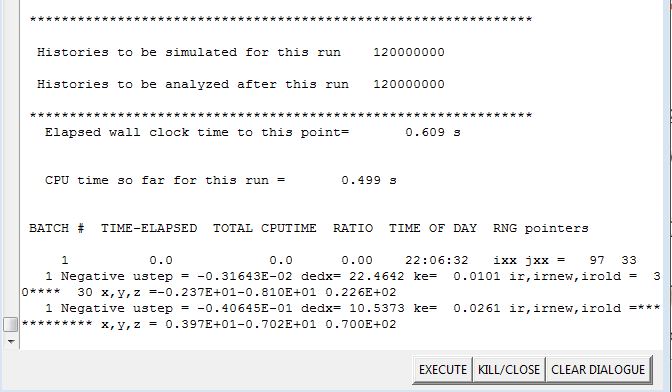
Hello everyone
When I run simulation on dosxyznrc I find this statement continuously….even after longer times. Can someone please identify that what is the mistake?
Thanks in advance!
Note that the post authors are incorrect. Find our current active community here: https://www.reddit.com/r/EGSnrc
Hello everyone
When I run simulation on dosxyznrc I find this statement continuously….even after longer times. Can someone please identify that what is the mistake?
Thanks in advance!
I’m running a simulation using the pyramids CM. It’s run before with no issues with no change to the geometry, I think. Now when i run it, the simulation goes just fine for about 10 minutes. Then, all of a sudden i get this warning about 1000x (sometimes when I run its YMax instead of XMax):
613 ‘ dist calculated to +YMAX from particle position inside material’/
614 ‘ surrounding opening (-XMAX < X(NP) < XMAX, Y(NP) < YN)'/
615 ‘ is < 0 (',F16.8,'). dist reset to 0.'//);
Then the error
831 (//’ ***ERROR in CM ‘,I4,’ (PYRAMIDS)’/
832 ‘ Particle in layer ‘,I4,’ incorrectly assigned to material’/
833 ‘ surrounding opening.’/
834 ‘ Total number of region errors at this point > 1000.’//);
I did the nefarious thing and removed the “STOP;” command from the pyramids_macro.mortran file where the error is handled. this got me past 8 minutes of running all the way to 30 minutes, but then it crashed the server.
Any hints on where I need to troubleshoot? Should I make my pyramids +/-ymax and +-xmax really big to avoid this?

Hello everyone
I have a problem, I have tried to use a space file of the IAEA, for a simulation in FLURZnrc. I have downloaded the files .IAEAphsp and .IAEAheader, I have placed them in the same directory and I get this error when running the simulation
thanks for your help

I simulated VMAT using dosxyznrc isource 20 with 1415 control points and the range of the dose fraction is 0-0.14 MU. I started to running but it can’t finish. When I checked in egslst, i found that it stopped at control point 1395. Could anybody find what’s the problem?

Hello everyone,
Because of not correctly installing the egs_gui, so I want to compile it on the command line. But after inputting the ‘make’, the command window display error.
And then checking the Makefile, I find there is “qmake” in the flie. So I want to ask if the reason of the error is from ‘qmake’.
Dose anyone has some suggestions?
Best respect
Hello all,
I have a basic question about using BEAMnrc sources in other user codes.
Will the BEAMnrc source particles always be diced based on the seeds given in the used BEAMnrc input-file?
If yes, can one think of an easy way to pass different seeds to the BEAMnrc source when calling from another user code?
Best wishes,
Stefan
Hello everyone.
Is there a way to create phase-space for a particular linac from measured data (i.e. %DD and profile data of comissioning)?
Best regards.
Hi everyone,
I simulated VARIAN 2100 CD 18 MV but i have a problem.
Profile for my geometry is as follows:
I need to input file for this LINAC.


Hi everyone,
I am making some modifications based on dosxyznrc codes, however I can’t find the variance reduction section as it is presented in dosrznrc codes.
Because of this,I don’t know how to cancel the variance reduction techniques.
Do you have some advices about it?

Hi everyone!
I’m working on a simple simulation with BEAMnrc: A rectangular slab of highly absorbing material covers half of the field, the other half remains an open field. The input source is a Varian TrueBeam phsp. I need to score the fluence behind the phantom to investigate the transition from phantom to open field (see picture).
Here is the problem: I need really good statistics for the subsequent analysis of the fluence. I can achieve that in the region behind the phantom, but I cannot do much about the open field. There is hardly any interaction happening and the uncertainty is basically the inherent uncertainty of the phsp source. While Varian provides huge phsp files, it’s simply not enough for my simulation.
I tried using a point source with a spectrum instead, so I could produce as many particles as I want. Sadly though, this ruined the physics because I could no longer see the influence of the finite source size.
What did work was to rotate the phantom by 90° and score the fluence (with beamdp) along the y- instead of the x-axis. Same for 180° and 270° rotation. This way, I produced 4 similar simulations, but the open field was generated from different “regions” of the phsp file. I then averaged the fluence, worked nicely, but x4 is still not enough for my purpose.
So by now I’m all out of ideas…
Maybe you have got some left?
 EGSnrc Google+ Archive